
Good Grief!
No, not another distressed reaction to whatever

For godly grief produces a repentance that leads to salvation without regret, whereas worldly grief produces death. (2 Corinthians 7:2)
In Chapter 7 of his 2nd Letter to the Corinthians, the Apostle Paul contrasts godly and worldly grief. The former is a source of liberation and life (very good grief). The latter produces death (not at all good grief).
Before I say more, I need to make the point that worldly grief is not the sadness one feels over the death of a loved one, or over the suffering of others, or even one’s own pain in most cases. Paul himself instructs Christians to weep with those who weep. Our Lord preaches, Blessed are those who mourn. I saw a ghastly social media post the other day, arguing that Christians should be happy when someone dies, since we assume they go to heaven. That’s not a Christianity responsive to the plain words of Jesus and his Apostles. That’s what happens when you spin theology apart from the Bible.
Paul is telling the Church that there is a grief that turns us toward God and life, and what he calls a worldly grief that turns us toward sin and death.
Worldly grief, in the context of 2 Corinthians 7, is being sad about being caught and/or punished. Paul was writing about his stern correction of particular sins in the Corinthian congregation. Worldly grief mourns the uncomfortable short term consequences of sin — getting caught, being embarrassed, paying a personal or material penalty — and this produces death as it can only reinforce us in the finite self-centeredness of our flesh.
Godly grief, on the other hand, is awareness of our rejection of God by disobedience to his word and indifference to his love. This is far from base grief over getting caught. The Apostle John teaches that There is no fear in love, but perfect love casts out fear. For fear has to do with punishment, and whoever fears has not been perfected in love.
Paul’s lesson is that godly grief turns us back toward God, and that this is joyful news, I rejoice, not because you were grieved, but because you were grieved into repenting. (2 Corinthians 7:10)
The joy is not just a quirk of Paul’s. It is the predisposition of heaven to rejoice when godly grief turns a sinner back toward God. Jesus says, Just so, I tell you, there is joy before the angels of God over one sinner who repents. (Luke 15:10)
Then there’s the Apostle James, blunt in his presentation of godly grief: Draw near to God, and he will draw near to you. Cleanse your hands, you sinners, and purify your hearts, you double-minded. Be wretched and mourn and weep. Let your laughter be turned to mourning and your joy to gloom. Humble yourselves before the Lord, and he will exalt you. (James 4:8-10)
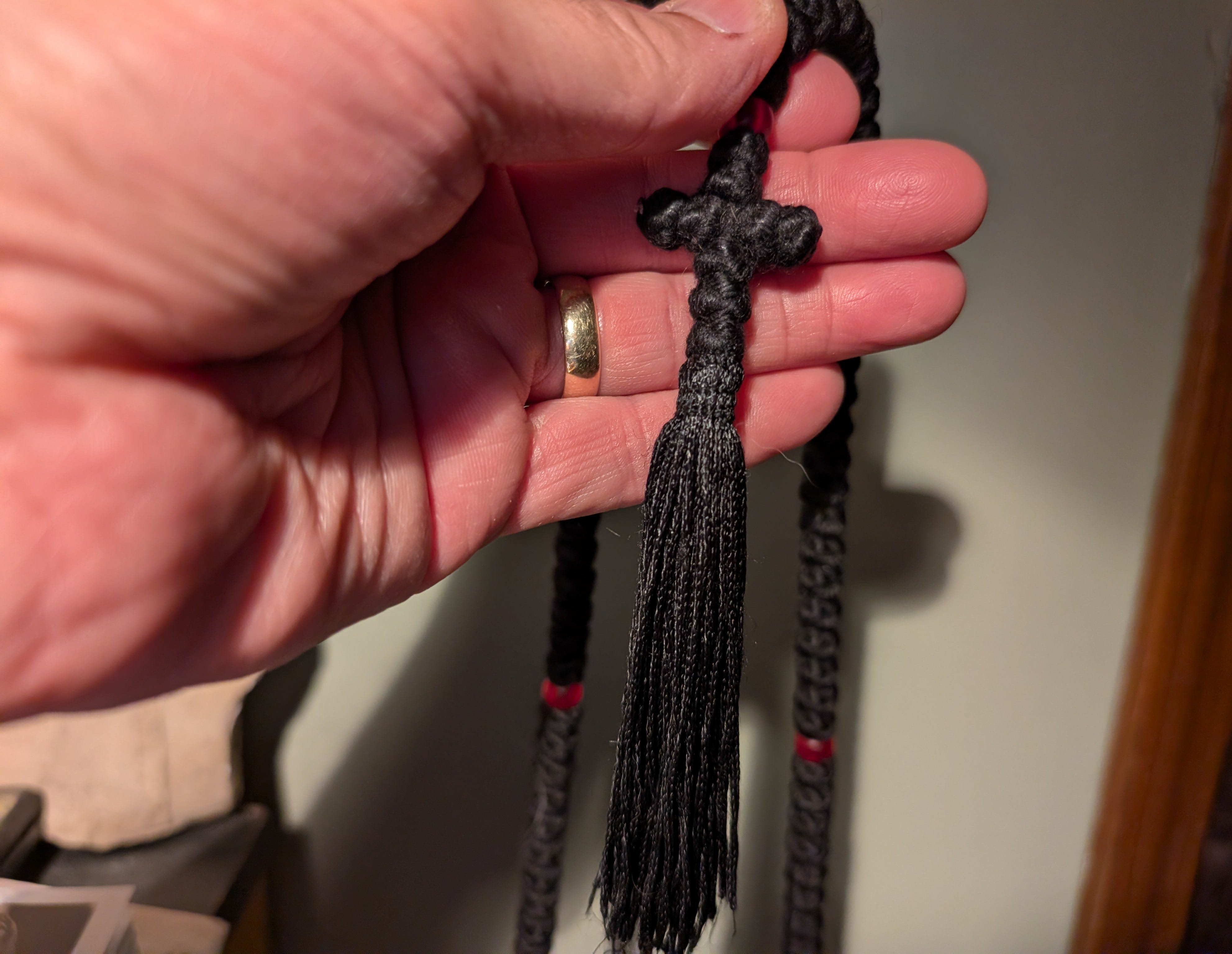
OK, the picture up above. It’s an Orthodox Prayer Rope. There are plenty of articles you can search if you’re curious about these. I’m not recommending or criticizing the item. I’m only showing one here to focus on the tassels at the end, which Orthodox sources say are for drying the tears shed due to sorrow for your sins (or, if you have no tears, to remind you to weep). I think that’s a good symbol and even a practical tool for godly grief. A reminder to weep, or at least find the personal sorrow of knowing and rejecting God’s love through our self-absorbed, self-centered ways.
Lent is on the horizon, and with it Ash Wednesday’s ancient call to godly grief, leading toward God’s love:
“Yet even now,” declares the Lord, “return to me with all your heart, with fasting, with weeping, and with mourning; and rend your hearts and not your garments.” Return to the Lord your God, for he is gracious and merciful, slow to anger, and abounding in steadfast love; and he relents over disaster. (Joel 2:12-13)