
I'm With Them
Praying for your imperfect church

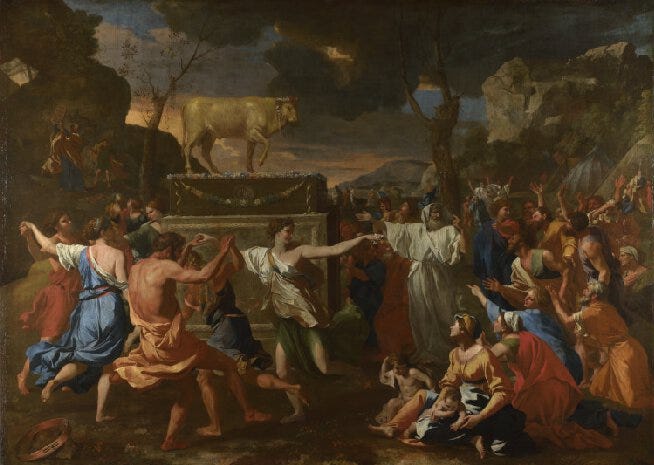
So Moses returned to the Lord and said, “Alas, this people has sinned a great sin. They have made for themselves gods of gold. But now, if you will forgive their sin—but if not, please blot me out of your book that you have written.” (Exodus 32:31-32)
God offered to wipe out the people and start over, in order to make a great nation with Moses as its leader (32:10).
Moses instead identifies with his idol-besotted people, interceding with God on their behalf, even asking to be destroyed with them if God will not turn from his burning anger (32:12).
Not sure I have enough love in my heart to ask God to nuke me on behalf of others. But Exodus 32 encourages me to pray for the church — local, denominational, and global. Moses’ example of identification with and intercession for God’s people suggests ways that we might pray with and for our brothers and sisters in Christ.
Start with God’s likes and dislikes. What does God want of my church and how are we falling short? And the Lord said to Moses, “Go down, for your people, whom you brought up out of the land of Egypt, have corrupted themselves. They have turned aside quickly out of the way that I commanded them. They have made for themselves a golden calf and have worshiped it and sacrificed to it and said, ‘These are your gods, O Israel, who brought you up out of the land of Egypt!’” (32:7-8)
You might not have a face to face with God on a mountaintop, but you have the Bible. Seek God’s will for your church (you included) there. Spend less time grousing about the color of the pew cushions and length of the sermons, and find out what corrections the Word of God might have for your church. The church doesn’t need more grievance groups. It needs attentiveness to God’s desires.
Agree with God in confession. So Moses returned to the Lord and said, “Alas, this people has sinned a great sin. They have made for themselves gods of gold.” (32:31) Bring the specific problem to God, and again, make sure it’s a problem that God cares about.
Enlist others. You might be on your own initially, but if others in the church come to recognize the correction it needs, have them join in the confession. …then Moses stood in the gate of the camp and said, “Who is on the Lord's side? Come to me.” And all the sons of Levi gathered around him. (32:26)
This needs to be done with humility and, if you’re not the Priest or Pastor, don’t go enlisting people to undermine the clergy (if that’s going on in your church, that’s a big need for intercession and repentance.) Moses was God’s chosen leader for the people — make sure that enlisting others to intercede for the church includes its ordained leaders, or at least gets their blessing.
Confess and intercede with others. The confessions of sin in most Anglican liturgies are corporate prayers (emphasis added with CAPS),
Almighty and most merciful Father, WE have erred and strayed from your ways… (Morning Prayer)
Most merciful God, WE confess that WE have sinned against you… (Holy Eucharist)
Remember not, Lord Jesus, OUR offenses… (The Great Litany)
Almighty God and Father, WE confess to you, to ONE ANOTHER, and to the whole company of heaven, that WE have sinned… (Compline)
Culturally, we tend to individualize. To bring the church together to confess a church-wide sin is uncomfortable. But for Anglicans, we have a treasury of Common Prayer, including forms for confession and for intercession,
That it may please you to give US true repentance; to forgive US all OUR sin, negligence, and ignorance; and to endue US with the grace of your Holy Spirit to amend OUR lives according to your holy Word, WE beseech you to hear US, good Lord. (The Great Litany)
Accept and undertake correction. Exodus describes a very different time, as God is reaching out to form a dedicated people while they wander in primitive, dangerous circumstances. So I’m not advising the violent remedies that followed the golden calf incident.
But to identify God’s grievance, to confess it and intercede for the church is to accept changes that God desires. This calls for Biblical teaching and study, sincere conversation, more prayer, fasting — any and all tools that help the church abandon what grieves God and take up what glorifies Him.
Thankfully, most changes to which God calls us are not as brutal as the golden calf correction. But church change is hard — we (rightly) look to the church to provide assurance and stability in the midst of a fallen world. So when God makes known His desire for change, our expectations of the church and the ways in which it pleases us can be shaken up.
Prior to my call as their Vicar, the people of one small church perceived God calling them into a challenging change. They gave up their familiar neighborhood church building, a spot to which many of them could walk, and bought property miles away, toward the center of their growing city. They built a place with an actual parking lot for people who hadn’t yet arrived, flexible spaces for ministries yet to launch, and an office for a Vicar still to be called. (None of those features were present in their original church building).
They wern’t doing anything “bad” in their original church. They were a small, friendly group of long time neighbors who came to recognize that God desires more from a church than the satisfaction of it members. They stretched themselves, took some risks, worked through squabbles, and rejoiced as the new pews and parking lot filled with new citizens of God’s kingdom.
On one of the first robustly attended Sundays, a venerable and usually staid member of the original congregation came up to me verging on giddy. Sweeping his hand toward the full parking lot, he said, “I thought we could do this. Just not this fast.”
I share this story because it glorifies God. It’s not a clergy hero story —the big spiritual decisions and risks were made well before I popped up as the name of a potential Vicar. Nor is it a “how to” story, although we certainly benefitted from practical mission guidance and diocesan financial support along the way.
It is a story of God’s people, one or two at first and then a whole group, responding to God’s desire and, with God’s grace, changing their lives and the lives of others in Christ.
“I’m with them,” said Moses in more dramatic fashion, renouncing his own satisfaction and exaltaion to identify with God’s imperfect people, and to submit himself to God on their behalf.
Might there be someone like that in your church? Might it be you?
God, You alone have the words of eternal life!!
You know the end from the beginning.